The Essay Revision Checklist: 12 Questions to Ask Before You Submit
There is a moment, usually around eleven at night, when an essay feels finished. The word count is right, the quotes are in, the file has a name that isn't draft 3 final final. You send it, and two days later you read it again and find the paragraph that should have opened the piece and the sentence that was never quite true.
The space between finished and ready is revision, and it is not proofreading. Proofreading catches the comma splice in the fourth paragraph. Revision asks harder things: is this an argument, or a tour of everything I read last month? Does it sound like a person? Does the ending arrive, or does it simply stop?
What follows is a checklist of twelve questions, ordered from the largest problem to the smallest. Work through them in sequence. There is no sense polishing a sentence inside a paragraph you are about to delete.
Two Questions About the Thesis
1. Can you say what the essay argues in one sentence, out loud, without looking at it? If the sentence needs three clauses and a semicolon, you may still be holding a topic rather than an argument. This essay explores the role of silence in Chekhov's short stories is a topic. Chekhov's silences do the work his dialogue refuses to do is an argument. Write your one-sentence version at the top of the document in bold and leave it there while you revise. Delete it before you submit.
2. Does the thesis appear early enough, and does it match what the essay actually does? A common failure: the introduction announces one argument, and the body quietly builds a different, better one. When the two disagree, trust the body. The introduction is a promise; the body is what you can actually deliver. Rewrite the promise.
Two Questions About Structure
3. Does every section earn its place? If you cannot say in one line why a paragraph is there, it is probably there because you liked the material. Liking the material is not a reason. Keep a note of the cut passages in a separate file if it helps you part with them.
4. Could you swap the order of two sections without losing anything? If yes, the structure is a container, not a claim. Order should mean something: this before that, because a reader has to believe A before B can land. Try the reverse outline — summarise each paragraph in five words in the margin, then read only those summaries. The shape of your argument will be visible in about ninety seconds, including the places where it doubles back or stalls.
Three Questions About Evidence
5. Does the evidence prove the claim, or does it merely sit near it? You assert that the narrator is unreliable, then quote a passage that is ambiguous at best. The quotation is adjacent to the claim, not support for it. Ask what a sensible reader who disagreed would say about that passage. If the answer is "fair point", you need different evidence or a smaller claim.
6. Have you explained the evidence, or only quoted it? A long block quotation followed by a new paragraph leaves the reader to do your job. Follow the quotation with a sentence describing what you see in it — not this shows the narrator's unreliability, which is a label, but something closer to the words themselves: which phrase hedges, where the tense slips, what the sentence refuses to name.
7. Have you answered the obvious objection? Not the flimsy version you can knock down in a clause, but the strongest one you can imagine a careful reader making. Give it a full paragraph and treat it honestly. An essay that survives its own best objection is worth ten that ignore it. If the objection damages your argument, adjust the argument. That is revision working properly.
Two Questions About Voice
8. Does the first paragraph sound like you? Many drafts open in a borrowed register — the school-essay register, the conference-paper register, the register of someone trying to sound authoritative. A useful test: could this opening paragraph begin a thousand other essays? If so, cut it and start where your actual curiosity starts. Very often that is paragraph three, and the piece gets better immediately.
9. Is there any sentence you would be embarrassed to say aloud? Read the draft at speaking volume, alone, with the door shut. The sentence you mumble or skip past is the one to fix. Usual suspects: it is important to note that, in many ways, society as a whole. A good sentence survives being spoken to one person across a table.
Two Questions About Pacing
10. Where does your attention dip as you read? Mark the spot; do not fix it yet. Most essays sag in the middle third, after the setup has done its work and before the payoff arrives. Check paragraph lengths too. Six paragraphs of five sentences each create a metronome, and a metronome sends readers to sleep. Let one paragraph run long where the thinking gets complicated, and let another be a single line.
11. What can you cut by ten percent? Cutting a tenth is a discipline, not a punishment, and the essay almost always improves. Try deleting the first sentence of every paragraph and see which paragraphs still work. That first sentence is frequently a runway — a warm-up the reader does not need. Keep the ones that genuinely set up what follows.
One Question About Endings
12. Does the last line land, or does it just stop? Three common failures. The summary, which restates what the reader already knows. The swerve, which introduces a new idea in the final two sentences and leaves it stranded. The fade, which repeats an image from the introduction without adding to it. A good ending returns to something earlier in the essay and makes it mean more than it did the first time. It should feel both inevitable and slightly surprising — the reader should think of course, and then, a beat later, but I hadn't seen that.
The Twelve Questions, in One Place
- Can you state the argument in one sentence, out loud?
- Does the introduction match what the body actually does?
- Does every section earn its place?
- Could you reorder sections without losing anything?
- Does the evidence prove the claim, or just sit near it?
- Have you explained the quotations, or abandoned them?
- Have you met the strongest objection honestly?
- Does the opening sound like a person?
- Is any sentence unsayable out loud?
- Where does attention dip?
- What can you cut by ten percent?
- Does the last line land?
Then do the small, unglamorous things. Print the essay and read it on paper, because errors hide on screens. Leave it overnight if you can — a single day away does more than an hour of staring. Check the brief one last time: word count, formatting, citation style, file name. Finally, read the first paragraph and the last paragraph back to back, with nothing in between. If they speak to each other, the essay is holding together. If they read like two different pieces of writing by two different people, you have one more edit to make. Then send it.
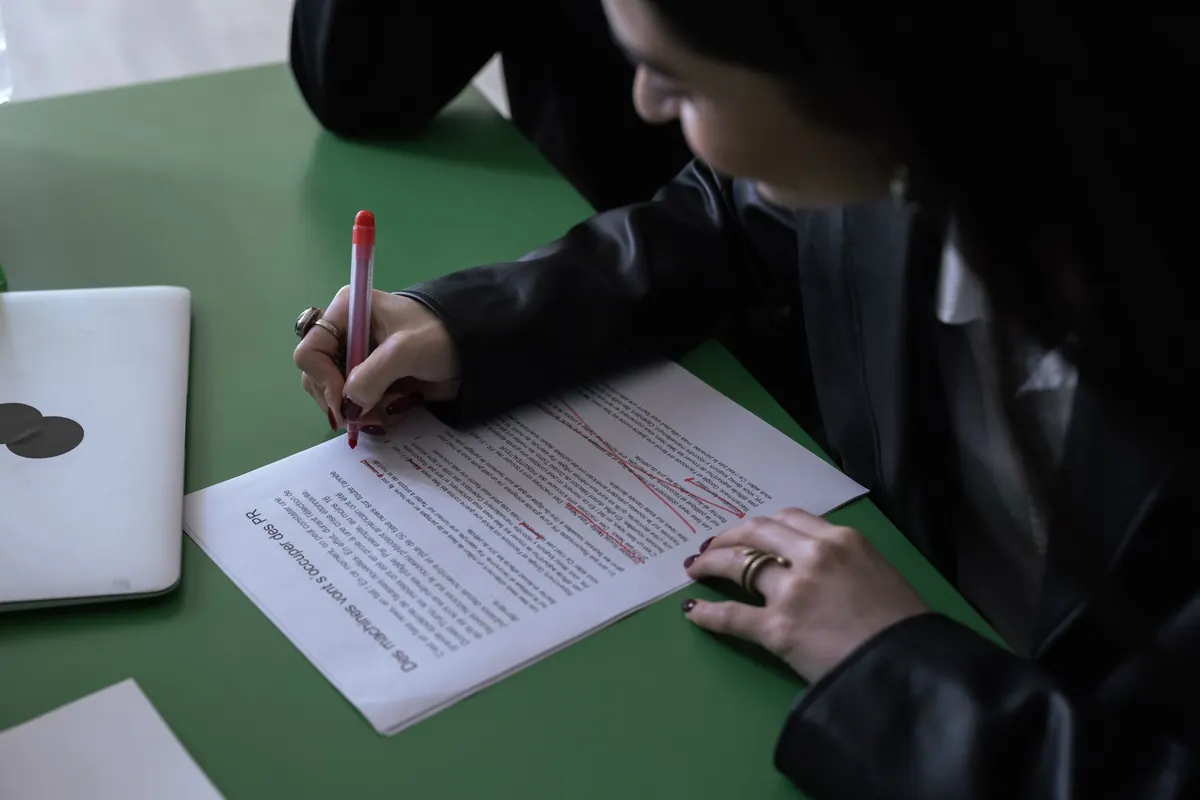
Photo: cottonbro studio / Pexels